Read a Free Preview of What the Body Knows
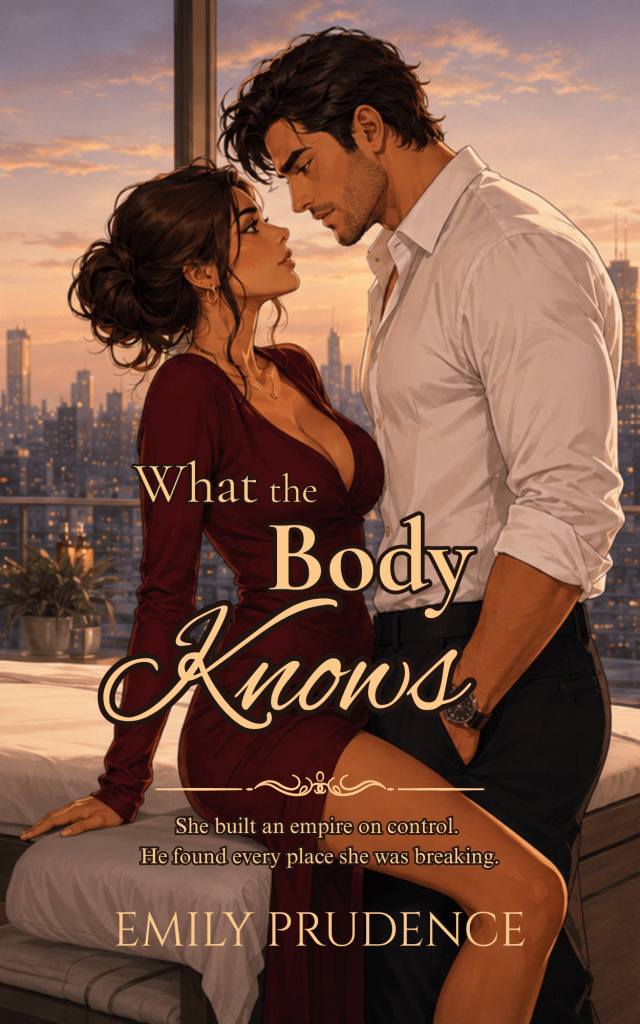
What the Body Knows
Chapter 1
Victoria Hawthorne sat behind her desk as if the office had been built around her.
In a way, it had.
Glass on three sides. Not the frosted kind used by people who liked the illusion of privacy, but clear, deliberate walls chosen by a woman who understood the value of being watched. The executive suite hovered above the rest of Hawthorne & Vale’s headquarters, its reinforced glass floor dropping thirty feet to the atrium below.
From here, she could see everything.
Project managers bent over blueprints. The financial team scrolling through spreadsheets in the east corner. Assistants moving between departments with coffee, tablets, and the strained smiles of people already behind schedule.
And they could see her.
That was the point.
Victoria’s dark hair was pulled back in a clean twist, not a strand out of place. Her blazer was the color of wet slate, tailored with the kind of precision that made soft things look dangerous. She had learned early that clothing was the first argument a woman made in any room. Before she spoke. Before she smiled. Before anyone decided whether they were foolish enough to underestimate her.
The morning was still young, not yet nine, but the skyline beyond her windows was already hard with construction cranes. Steel climbed into the pale autumn light, skeletal and ambitious, the city rebuilding itself one contract at a time.
She reached for her coffee.
Her hand trembled.
Barely.
A small betrayal. A flutter through the fine bones of her wrist and into her forearm. Nothing anyone else would have noticed.
Victoria noticed.
She set the mug down before it reached her mouth and turned to her inbox as if that had always been the plan. Her jaw tightened. Her breath shortened. Somewhere between the last budget revision and the fourth hour of sleep she had pretended was enough, her posture had begun to fold forward at the base of her spine.
Without permission.
She forced herself straight.
The body was an animal.
A disobedient one.
Victoria had spent years teaching hers to shut up.
On her desk lay the Riverside bid: three hundred million in concrete, glass, labor, risk, and every expensive mistake that could happen between signing and completion. The foundation alone would take four thousand cubic yards of poured cement. Enough to fill the swimming pool she technically owned and had used exactly twice.
The timeline was brutal. The budget tighter than the board liked. And their competitors were circling with the patient confidence of men who had spent ten years expecting her to fail.
They were going to die disappointed.
She had adjusted the load calculations twice already. The structural engineer had raised an eyebrow, then a question. Victoria had answered both and moved on.
That was what Hawthorne & Vale did.
It built things that stood.
So did she.
A shadow fell across her desk.
Not the quick, nervous pass of an assistant. Not a project lead hovering with a problem he hoped someone else would solve. This shadow did not hesitate.
Victoria knew who it was before she looked up.
Alistair Hawthorne stood in her doorway.
He did not knock. Knocking, in his opinion, was for people who needed permission.
Her grandfather wore his age the way he wore his suits: deliberately. His silver hair was combed back, his charcoal jacket immaculate, his burgundy tie knotted with old-world severity. He belonged to an era of men who treated appearance not as vanity, but as discipline.
His posture was perfect.
Annoyingly, it made Victoria aware of her own.
“Good morning,” he said.
His voice carried. It always did, even when he kept it low.
Victoria did not rise. “You’re early.”
“I am.”
He stepped inside and closed the door behind him. Quietly. Finally.
Then he moved to the window and looked out over the atrium below, the cranes beyond, the whole empire of steel and glass that carried his name and, one day, would carry hers without apology.
“The board meeting was moved,” he said. “Thursday instead of Friday.”
She did not ask why.
The why was not why he had come.
“The Riverside bid,” he said. “You sent the revised figures last night.”
“At eleven.” She kept her voice neutral.
Eleven was early, for her.
“At two in the morning, Victoria.”
She hated that he knew that.
The correction was gentle enough to pass as concern, which somehow made it worse. He had been awake. He had checked the timestamp. He had noticed.
And if he had noticed that, he might have noticed the rest.
The late nights. The way her right shoulder caught when she reached for the upper cabinet. The stiffness she had started hiding beneath sharper tailoring. The tremor she had just set down with her coffee and pretended never happened.
“The numbers needed to be right,” she said.
“The numbers are always right with you,” Alistair said. “That is not what concerns me.”
Victoria looked at him.
Really looked.
His face was lined but not soft. His eyes were pale, steady, and far too patient. It was the kind of patience that made other people start talking just to escape it.
Victoria did not start talking.
She had learned that from him.
“You look tired,” he said.
“I’m not.”
“You are.” His voice did not sharpen. That made it worse. “And before you waste both our time saying it again, remember that I’ve watched you push yourself for thirty years. I know the difference between determination and damage.”
Damage.
She hated the word on contact.
“I am functional.” Each syllable came out clean and measured, a blade she had polished until it reflected nothing. “I am meeting every deadline. Riverside is solid. Westridge is back on schedule as of yesterday. There is no damage.”
Alistair stayed at the window with one hand in his pocket. Still. Immoveable. Worse than an argument.
“Functional is not the standard I set for you,” he said. “And it is certainly not the standard you set for yourself.”
“Then what is?”
“Thriving.”
The word was quiet.
“Not surviving.”
Something in her chest pulled tight.
Victoria turned slightly in her chair and reached for the folder on the edge of her desk. The movement caught low in her back, a bright line of pain so sharp it stole half a breath before she could stop it.
She recovered.
Of course she recovered.
Alistair’s expression did not change. Not enough for anyone else to notice. But Victoria knew him better than anyone in the building, and she saw the small shift in his eyes.
He had seen it.
“You will see the specialist,” he said.
Not a suggestion. Alistair rarely wasted breath on those.
“I don’t need a specialist.”
“His name is Damien Vale. He comes highly recommended.”
The name landed between them with an irritation she did not bother to hide.
“Vale?”
“No relation to the company name,” Alistair said, because of course he had anticipated the objection before she made it. “He works with structural strain, chronic pain, mobility issues, and high-performance clients too stubborn to seek help before their bodies force the matter.”
Victoria’s mouth curved.
It was not a smile.
“That sounds convenient.”
“It is. I dislike inconvenience.”
“I don’t have chronic pain. I have a schedule.”
“You have both.” His gaze held hers. “The schedule is negotiable. The pain is not.”
Victoria stood.
The movement cost her. She kept the pain out of her face, but her body collected its debt anyway: lower back, right hip, the familiar pull beneath her shoulder blade.
She moved to the window and stood beside him.
The city looked ordered. Planned. Steel, glass, cranes, men in hard hats, contracts made visible. Everything in its place. Everything holding its weight.
“I built this company with you,” she said. “Not for you. With you. I have never asked for special treatment. I have never used my name as an excuse. I have outworked everyone in this building for fifteen years, and I am not going to start handing them weakness because you’ve decided I look tired.”
“Victoria.”
She turned on him. “If I walk into that office, the board hears about it. The project leads hear about it. Every man who has waited for proof that a woman cannot run a construction firm hears about it. You are asking me to give them the one thing they’ve wanted since you put me in this chair.”
“I am asking you,” Alistair said, “to be the one who survives what we built.”
The words were quiet.
They were also the closest thing to fear she had ever heard from him.
That, more than anything, made her go still.
This stern, impossible man had raised her, trained her, corrected her, sharpened her. He had taught her how to read contracts, how to stand her ground, how to make powerful men regret underestimating her without ever raising her voice. He had given her steel, then expected her to become it.
And now he stood in her glass office asking her to admit she was human.
Worse.
He was not asking.
Victoria understood then that she had lost the argument before it began. Not because he was right. She would never give him that satisfaction out loud. But because he had used the one thing she could not outmaneuver.
His authority.
Not as power.
As care.
She would go. She would sit in Damien Vale’s office. She would allow him his little examination. She would answer what was necessary, reveal nothing that mattered, and prove to everyone, including herself, that being assessed was not the same thing as being exposed.
“Schedule the appointment,” she said.
Her voice did not shake.
She made certain of it.
Alistair nodded once.
He did not thank her. He did not soften. He simply turned and left her office the way he had entered it: without asking permission, without making a sound.
When the door closed, Victoria remained at the window.
Her reflection appeared in the glass, laid over the city like a second skyline. Slate blazer. Perfect posture. Composed face. Hands steady at her sides.
She held the image.
Held it until her breathing evened.
Held it until the pain in her back settled into something she could ignore.
Held it until the reflection stopped looking like a performance and started looking, once again, like the truth.
Nothing would break her.
Not the pain.
Not the appointment.
Not the watching eyes of a company built to withstand pressure far greater than one woman’s body could ever generate.
Victoria turned back to her desk.
The Riverside bid waited. The day had barely started.
She picked up her coffee.
Her hand did not tremble. Not this time.